
Service · Orlando, FL
Energy Efficiency Retrofits in Orlando
Economizers, VFDs and controls upgrades sized to your building’s actual usage data, so the retrofit pays for itself on your utility bill instead of just checking a sustainability box.
Energy efficiency retrofits for Orlando commercial buildings
Florida’s cooling season runs nearly year-round, which means a commercial building’s HVAC system is usually the single largest line item on the utility bill. Unlike a rooftop unit replacement, which is a defined scope tied to equipment failure, an energy efficiency retrofit is a customized project built around what a building actually uses and where the biggest waste is happening — which is why we do not sell a one-size package here. We start with a real look at usage data and equipment condition, then recommend what actually pays back, not what carries the highest margin.
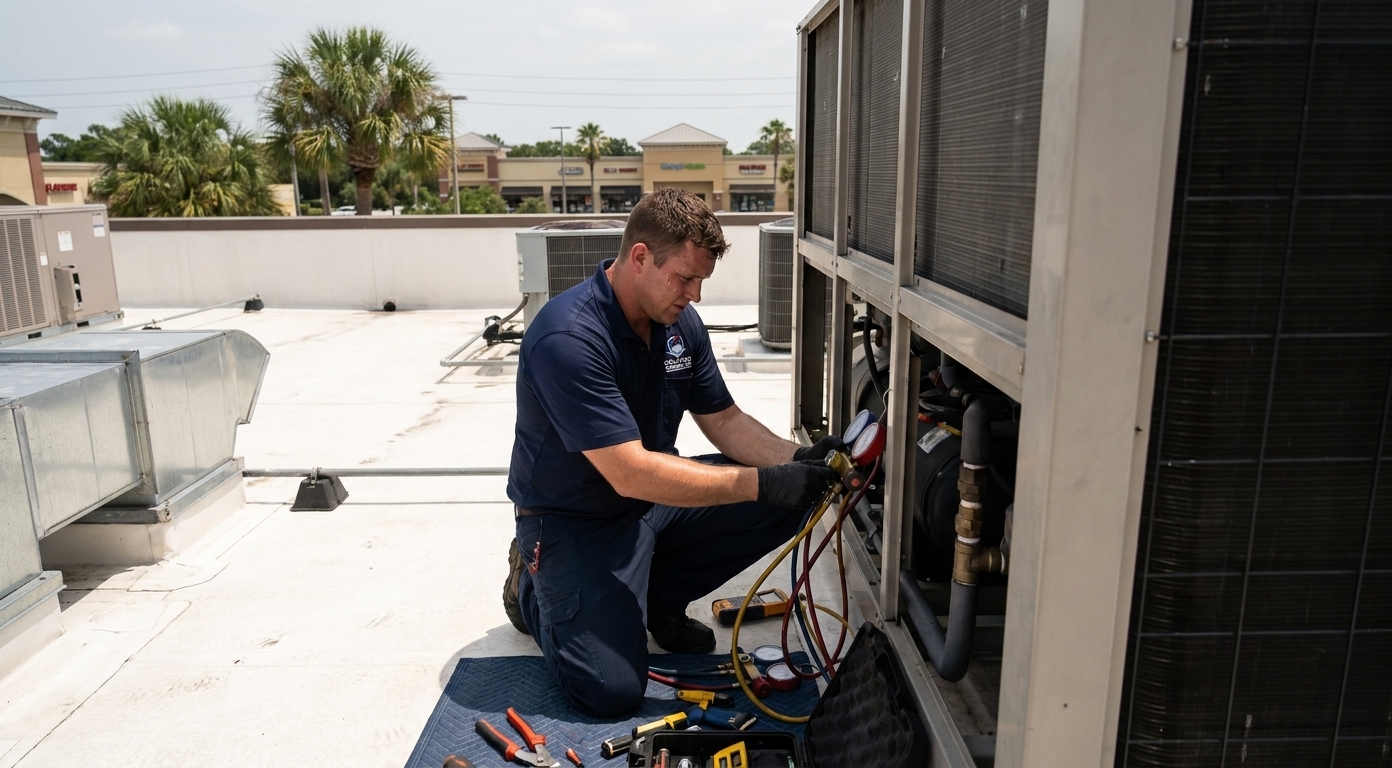
The three retrofit categories we run most often are economizer additions or repairs, variable frequency drives (VFDs) on fan and pump motors, and building automation or thermostat controls upgrades. Each targets a different source of waste, and most buildings benefit from some combination of the three rather than just one.

Economizers — free cooling when outside air is right
An economizer uses outside air for cooling when outdoor temperature and humidity conditions allow it, reducing mechanical cooling runtime. In Orlando this matters most during shoulder-season mornings and evenings when outdoor conditions are actually favorable, which is a real but narrower window than in a drier or cooler climate — a poorly tuned or stuck economizer, though, is a straightforward and common source of wasted energy we find during retrofits, since a stuck-open damper in humid conditions actually increases cooling load rather than reducing it. Fixing or properly commissioning an existing but non-functional economizer is often the highest-return retrofit item on a given unit.
Variable frequency drives on fans and pumps
A standard fan or pump motor runs at full speed continuously regardless of actual load, which wastes energy during the many hours a building is not at peak demand. A VFD lets that motor ramp down to match actual load, and because fan power scales roughly with the cube of speed, even modest speed reductions produce outsized energy savings. This applies most clearly to larger buildings with air handler supply fans, condenser water pumps on chiller plants, and cooling tower fans — equipment that runs long hours at partial load most of the time.
Controls and building automation upgrades
A surprising amount of commercial HVAC waste comes down to simple scheduling and setpoint problems — a system running full cooling on a Sunday when the building is closed, a setpoint left at an aggressive temperature from a one-time complaint months ago, or zones fighting each other because a thermostat schedule was never updated after a tenant change. A controls or building automation system (BAS) upgrade fixes this at the source, and it is often the lowest-cost, fastest-payback retrofit available because the hardware cost is modest compared to the ongoing waste it eliminates.
We frequently find multi-tenant and multi-zone buildings where nobody currently owns the thermostat schedules at all — they were set once during initial construction and never revisited as tenants changed or hours shifted. A short audit of every zone’s actual schedule against its actual occupancy pattern often turns up hours of unnecessary conditioning per week without touching a single piece of mechanical equipment, which is why we always start a retrofit proposal with a controls review even when the eventual project also includes economizer or VFD work.
What a retrofit costs and how it pays back
Every retrofit is a custom quote because the scope depends entirely on the building’s equipment, usage pattern and current controls, but the ranges below reflect what similar Orlando-metro commercial retrofits typically run.
| Retrofit | Typical range | What moves the price |
|---|---|---|
| Economizer repair/commissioning, per unit | $400 – $1,200 | Existing hardware condition |
| New economizer install, per unit | $1,500 – $4,500 | Unit compatibility and ductwork changes |
| VFD install, fan or pump motor | $2,000 – $6,000/unit | Motor size and electrical integration |
| Smart thermostat/controls upgrade, per zone | $400 – $1,200 | Zone count and existing wiring |
| Full building automation system (BAS) install | Custom quote | Building size and integration scope |
| Energy usage assessment | Free with retrofit proposal | — |
Where retrofits fit with repair and replacement
A retrofit is often bundled with an RTU replacement project, since a new unit is the natural point to add or upgrade an economizer and controls integration at the same time rather than as a separate mobilization later. If your equipment is still serviceable, a standalone economizer or controls retrofit can be added without touching the mechanical unit itself.
Where we run efficiency retrofits
We run retrofit projects throughout Orange County and the surrounding metro, including Downtown Orlando, International Drive, Altamonte Springs and Dr. Phillips, with no trip charge anywhere on our normal route.
Questions
Energy Efficiency Retrofit FAQs
It depends entirely on scope. Economizer repairs run $400 to $1,200 per unit, new economizer installs run $1,500 to $4,500 per unit, and VFD installs run $2,000 to $6,000 per motor. A full building automation system is a custom quote based on building size and integration scope.
Most economizer and controls retrofits we run pay back in roughly two to five years depending on the building’s usage pattern and current utility rates. We provide a realistic payback estimate specific to your building before you commit to a project, not a generic industry figure.
Yes, though the window is narrower than in a drier or cooler climate. Economizers provide real savings during shoulder-season mornings and evenings when outdoor conditions allow it, and fixing a stuck-open economizer damper is often the highest-return retrofit item on a given unit since a malfunctioning one actually increases cooling load.
A variable frequency drive lets a fan or pump motor ramp down to match actual load instead of running at full speed continuously. Because fan power scales roughly with the cube of speed, even modest speed reductions produce outsized energy savings on equipment that runs long hours at partial load, like air handler fans and condenser water pumps.
Yes, often more than expected. Simple scheduling and setpoint problems, like a system running full cooling on a closed day or an outdated tenant schedule, are common and inexpensive to fix, which is why controls upgrades are often the fastest-payback retrofit available.
No. Economizer and controls retrofits can be added to existing, still-serviceable equipment without a mechanical replacement. Retrofits are also commonly bundled with a planned RTU replacement to avoid a separate mobilization.
Yes, we review your building’s actual usage data and current equipment condition as part of a free assessment before proposing a retrofit scope, so the recommendation is based on your building, not a generic package.
Rebate programs change and vary by utility provider. Ask your account contact whether a current rebate program applies to your project during the estimate.
Yes, we retrofit both individual rooftop package units and central plant equipment like chiller condenser water pumps and cooling tower fans.
Yes, installation work carries a written workmanship warranty, and manufacturer warranties apply to the equipment installed. We will explain exactly what is covered before you approve a project.
Related
Other commercial HVAC work we do
Get a custom energy retrofit quote
Free usage assessment and a realistic payback estimate before you commit to a project. Call or send us a recent utility bill to get started.
24/7 Emergency Service — Office Mon–Fri 7:00am–6:00pm · Licensed & insured · Serving Orlando and the Central Florida metro